Friday, February 3, 2023

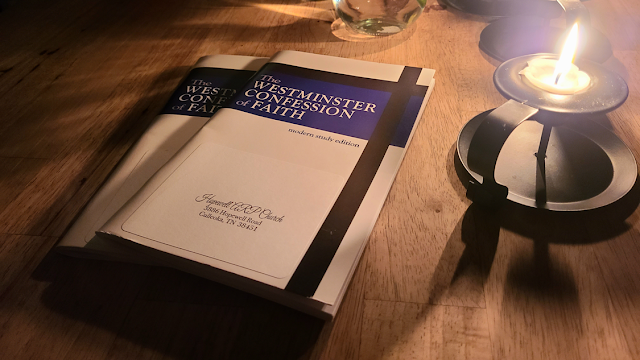
(WCF 3.2–4) Truth to Treasure: Predestination unto Life and Foreordination unto Death

 The following is my monthly contribution to Seventeen82 for February, 2023.

(WCF 3.2–4) Truth to Treasure: Predestination unto Life and Foreordination unto Death

3.2 Although God knows whatsoever may or can come to pass upon all supposed conditions, yet hath he not decreed anything because he foresaw it as future, or as that which would come to pass upon such conditions.

Does God know all hypothetical futures? Of course.

Friday, January 27, 2023

Please Pray for B———

Please pray for B——— to be given the new birth, saving faith in Jesus Christ, and repentance unto life.

Friday, January 20, 2023

Persistence in Holding Fast to a Person

 Joshua 22:2,5 (NKJV)

     2 and said to them: “You have kept all that Moses the servant of the Lord commanded you, and have obeyed my voice in all that I commanded you. […] But take careful heed to do the commandment and the law which Moses the servant of the Lord commanded you, to love the Lord your God, to walk in all His ways, to keep His commandments, to hold fast to Him, and to serve Him with all your heart and with all your soul.”

Persistence in faithfulness and obedience is a work that is never done. But it is more than a work. It is holding fast to a Person.

You Have Heard of Perseverance, and Compassion, and Mercy!

James 5:11 (NKJV)
     11 Indeed we count them blessed who endure. You have heard of the perseverance of Job and seen the end intended by the Lord—that the Lord is very compassionate and merciful.

Genesis 50:20 (NKJV) 
     20 But as for you, you meant evil against me; but God meant it for good, in order to bring it about as it is this day, to save many people alive.

Neither Job nor Joseph knew, in the midst of their trials, the purpose of their trials. But the Lord recorded them so that we might “hear” of them. In them, we hear the primary message: “the Lord is very compassionate and merciful.” And in them, we learn to look to God for the same thing that He produced in them “perseverance.” May the Lord give us the perseverance of Job! 

The Danger of Hearts Fattened upon Temporal, Earthly Things, Rather Than upon Christ

James 5:1–8 (NKJV) 
     1 Come now, you rich, weep and howl for your miseries that are coming upon you! Your riches are corrupted, and your garments are moth-eaten. Your gold and silver are corroded, and their corrosion will be a witness against you and will eat your flesh like fire. You have heaped up treasure in the last days. Indeed the wages of the laborers who mowed your fields, which you kept back by fraud, cry out; and the cries of the reapers have reached the ears of the Lord of Sabaoth. You have lived on the earth in pleasure and luxury; you have fattened your hearts as in a day of slaughter. You have condemned, you have murdered the just; he does not resist you.
     Therefore be patient, brethren, until the coming of the Lord. See how the farmer waits for the precious fruit of the earth, waiting patiently for it until it receives the early and latter rain. You also be patient. Establish your hearts, for the coming of the Lord is at hand. 

When one is “rich” (v1), he is in great danger of having his treasure (v3) or nourishment (“fattened,” v5) be in something other than Christ Himself. How dangerous! As we prepare to meet the Lord of Hosts (v4, 8), let us learn to have hearts that treasure Him and are nourished by Him (v8).

Is Your Guru's Mouth Full of Christ?

One of the features of my life (maybe I'll write a bit about my life one day; it's my personal blog, after all) is trudging back and forth past the front desk at the gym in order to prolong my time in the sauna non-lethally, by means of the one drinking fountain in the entire building.

Yesterday, over the course of five of these trips in one hour, one of the fitness instructors was regaling the very patient front desk staff with her sagacious counsel on every aspect of life, health, fruitfulness, and fulfillment. Maybe it's a fitness instructor thing. Her mouth was full. Full of ideas. Full of techniques. Full of motivations. But it wasn't full of Christ. How refreshing it was to return to the oppressive climate of the sauna and find the streams of the living water of Christ again in the little calfskin book!

God's mouth is full of Christ. And if you have an earthly teacher and example whom you follow, I hope his mouth is similarly full of Christ. Since ministers of the gospel are called to be such teachers and examples, let our mouths always be full of Christ!

I know a thing or two about a thing or two. But I have learned, over the years, not to have my mouth full of everything that I know (Pr 14:33, 29:11). One reason is that I don't want to create other avenues for resistance, when so much of the flock's health and growth relies (instrumentally under sovereign providence) upon how they receive my words. Another reason is that I don't want to weaken by diffusion the flock's resting upon Christ through His means by their attempting to do many wise things, however prudent and beneficial they may be. But the biggest reason is this: I hope for my mouth to be as full of Christ as possible. It's more aimed at than realized thus far, but I do wish to be able to say,

"I resolved to know nothing among you, except Jesus Christ, and Him crucified."

Ministers, too, have those whom they listen to and those whom they emulate. I hope that mine will be those whose mouths are always full of Christ. Christ Himself. The glory of His person and nature. The excellence and effectiveness of all His works. The sweetness and gladness of knowing Him. The restfulness and invigoration of serving Him. Whatever is of Him. Let it just be of Him!

Is your guru's mouth full of Christ?

Wednesday, December 28, 2022

Why Man-Made Holy Days Are Wrong (Along with Any Other Complications of Worship)

'Tis the season to answer again the most important question: what is the right way of coming to God? Answer: "Only the way that He says to come." Any answer beyond this inevitably means adding something to Christ. 

There are of course circumstance and selection questions that must be answered in the course of doing what God has commanded as the worship that comes through Christ. But anything that we add, or that we sneak in by way of "circumstances and forms," is a man-made complication to the simplicity that was "just as the LORD had commanded" under Moses and is now an even simpler simplicity under Jesus.

So, what is wrong with any man-made complication of worship? hpwl.org/worship
1. Only worship that God seeks actually finds God. John 4:16–26; Heb 8:1–6. 
2. God Himself says that man-complicated worship treats Him as common and creaturely instead of as holy. Lev 9:18–10:7; Heb 12:28–29.
3. Jesus Himself says that man-complicated worship is vain and heartless (regardless of how we feel about it). Matt 15:1–20; Isa 29:9–16.
4. Man-complicated worship departs from the worship service that is led by Christ from heaven. It thus fails to come to God through Christ. Heb chs. 1–12.
5. God calls those who offer it, "Them that hate Me." Deut 5:8–10; Deut 4:1–24.

Monday, December 26, 2022

Why Do We Do the Religious Things That We Do?

 "I mean for this to be about Jesus" or "I feel that this is about Jesus" or "This 'makes me feel' about Jesus" are no substitute for "Jesus says that this is about Himself."

Tuesday, December 20, 2022

Where to Begin: God [Dec, 2022, Contribution to Seventeen82]

This article first appeared at Seventeen82


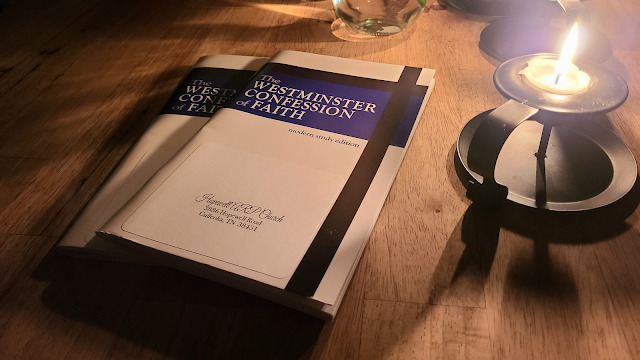
As ARPs, it is by means of the Westminster Confession and Catechisms that we obey the Scriptural mandate to maintain a pattern of sound words. By the Confession’s own viewof the Holy Scriptures, such patterns of sound words must be servants of Scripture, not substitutes, or even supplements. This is what we might call the preliminary principle of Reformed Presbyterianism.

Wednesday, November 2, 2022

Our Pattern of Sound Words: the Westminster Confession’s View of Itself in the Light of Scripture [Nov, 2022, Contribution to Seventeen82]

This article first appeared at Seventeen82.


As we’ve seen from Scripture, the Lord’s people must remember Him and His Word to themselves and their children for perpetual generations. And the Spirit’s method for this features the use of patterns of sound words (e.g. confessions and catechisms). As ARPs, we obviously think that the Westminster Confession and Catechisms are such patterns. What makes them so?

The first answer is that our confession acknowledges that Scripture alone is the rule of faith and practice. The reason that the truth in chapters 2–33 is sound and profitable is found in chapter 1, “Of the Holy Scripture.” This little article will be most helpful to you if read side-by-side with that chapter.

Holy Scripture is God’s Self-revelation. WCF 1.1 teaches that God has committed His revelation

Wednesday, October 26, 2022

An Island of Grace in a Season of Judgment

Joshua 14:7 I was forty years old when Moses the servant of the Lord sent me from Kadesh Barnea to spy out the land, and I brought back word to him as it was in my heart. Nevertheless my brethren who went up with me made the heart of the people melt, but I wholly followed the Lord my God. So Moses swore on that day, saying, ‘Surely the land where your foot has trodden shall be your inheritance and your children’s forever, because you have wholly followed the Lord my God.’ 10 And now, behold, the Lord has kept me alive, as He said, these forty-five years, ever since the Lord spoke this word to Moses while Israel wandered in the wilderness; and now, here I am this day, eighty-five years old.

The wilderness wandering was one of the great seasons of judgment in all of human history. In the midst of it, Caleb was an island of God’s grace. So we may look to the Lord to work in us, even if the general disposition of heaven toward the church at the time is one of exposing and chastising hardness to the Word.

The Danger of Envy

Acts 13:44 On the next Sabbath almost the whole city came together to hear the word of God. 45 But when the Jews saw the multitudes, they were filled with envy; and contradicting and blaspheming, they opposed the things spoken by Paul.

How great is the danger of a heart poisoned by envy! By it, the Jews in v45 cut themselves off from giving a hearing to the very gospel preaching by which faith comes; instead, they became contradictors and blasphemers of Christ.

The Role of Diligence in the Battles of Ai

Joshua 7:3 And they returned to Joshua and said to him, “Do not let all the people go up, but let about two or three thousand men go up and attack Ai. Do not weary all the people there, for the people of Ai are few.”

Joshua 8:3 So Joshua arose, and all the people of war, to go up against Ai; and Joshua chose thirty thousand mighty men of valor and sent them away by night.

Note the difference in diligence. God didn’t give victory as a reward for diligence. He gave it by way of diligence that He gave as a gift, His own blessing upon the repentance that He had given by way of judging Achan. Diligence is valuable, but if we lack it, then perhaps what we are first needy of is to clear our conscience before the Lord from Whom diligence comes by grace.

Monday, October 24, 2022

Christ's (True) Church Is a House of Prayer

Isaiah 56:7 Even them I will bring to My holy mountain,

And make them joyful in My house of prayer.
Their burnt offerings and their sacrifices
Will be accepted on My altar;
For My house shall be called a house of prayer for all nations.”

Acts 15, Numbers 16, and Respecting the Lord's Ordained Servants

24 Since we have heard that some who went out from us have troubled you with words, unsettling your souls, saying, “You must be circumcised and keep the law”—to whom we gave no such commandment25 it seemed good to us, being assembled with one accord, to send chosen men to you with our beloved Barnabas and Paul,
Acts 15:24–25 (NKJV)

One of the things that we’re seeing, where our congregation is in the book of Acts, is that it is important to yield to Christ’s rule by His Spirit in His church through those particular men that He sets apart to teach and to lead. The bad doctrine of the Judaizers was married to bad ecclesiology: self-appointed teachers who took it upon themselves to go to Antioch and preach what was on their hearts.

Resisting the Lord’s servants or trying to make our own alternative way isn’t new, and God takes it very seriously. Consider Numbers 16 (quoted at length below). We shouldn’t be surprised that those from Antioch would end up zealous for hellish doctrine, or that those today who have faithful ministers but instead google their theology end up self-assured about their own self-condemning spiritual ideas.

Republicationism and the Churches of Asia Minor

There are some who erroneously consider the promises of covenant blessing to Israel, and threats of covenant curses, to view Sinai not as an administration of the covenant of grace but as a republication of the covenant of works. Following their logic, we could end up saying the same about the seven letters in Revelation 2–3. Suddenly, the fact that the Lord deals covenantally with the visible church could become a trojan horse by which we begin to see "covenant of works" everywhere. 

No, the danger of covenant curse is an active reality for congregations of the visible church in the current administration of the covenant of grace. We need to be able to grapple meaningfully with the danger to churches within the covenant of grace of so resisting Christ that He removes our lampstand.

I Find (Y)Our Lack of Faith Disturbing

It takes a stunning hard-heartedness toward the Lord Jesus to have the option to be singing His praise and hearing His Word in the fellowship of the saints and choose instead games and frivolity or amusements. 

Yes, there is such a thing as physically or mentally needing more rest (sometimes due to failure to get it in a timely manner because other time was filled with too much frivolity and amusement), etc. But don't let the point die the death of a thousand qualifications. I'm not here thinking about tallying up actions, following rules, etc. 

I'm just thinking about priority of preference.

Saturday, October 8, 2022

Numbers 28:3–10 and the Morning+Evening Worship Pattern. Daily in our homes. Double on the Lord's Day.

“And you shall say to them, ‘This is the offering made by fire which you shall offer to the Lord: two male lambs in their first year without blemish, day by day, as a regular burnt offering. The one lamb you shall offer in the morning, the other lamb you shall offer in the evening, and one-tenth of an ephah of fine flour as a grain offering mixed with one-fourth of a hin of pressed oil. It is a regular burnt offering which was ordained at Mount Sinai for a sweet aroma, an offering made by fire to the Lord. And its drink offering shall be one-fourth of a hin for each lamb; in a holy place you shall pour out the drink to the Lord as an offering. The other lamb you shall offer in the evening; as the morning grain offering and its drink offering, you shall offer it as an offering made by fire, a sweet aroma to the Lord.

‘And on the Sabbath day two lambs in their first year, without blemish, and two-tenths of an ephah of fine flour as a grain offering, mixed with oil, with its drink offering—10 this is the burnt offering for every Sabbath, besides the regular burnt offering with its drink offering.
Numbers 28:3–10

Daily evening and morning rest during creation
One of the things that we recently saw in the “Biblical Theology of the Diaconate” series at Hopewell is that the interconnection between work-service and worship-service began even before day 7 of the creation (which, incidentally, was the first full day of Adam’s—and especially his wife’s—life).

Each day, there was an evening time and a morning time that were distinct from the creation-work times. So also, the pattern holds up for us in God’s creational ordering of things that we physically need an evening time to wind down and a morning time to warm up.

Daily morning and evening worship for God’s people
And those who live in fellowship with God find that these are important times for worship as well. This holds true not only for our individual/private/secret worship but also for set times of leading our children “when you rise up and when you lie down.”

Weekly morning and evening worship on the Sabbath
Now here, in Numbers 28, we see the connection between these daily set times and the entire day that God had consecrated and blessed for the same purpose. In vv3–8, we see the lamb-in-the-morning and lamb-in-the-evening pattern that belongs to every day. Then in vv9–10, we see that this is doubled on the consecrated and blessed Day.

“How much more so” in the age of the Lamb
We no longer offer lambs, because the Lamb slain from the foundation of the world now sits upon the throne. But, we know that the Lord’s pattern of coming to God through the Lamb, morning and evening, every day holds true.

For those of us who can see the obvious connection of resting from work in the creation (Gen 2); to the corporate observation of that in holy convocation of resting from work as a church/state (Ex 20/Deu 5); to the anticipated revival of resting from work in order to be trained in Lord-delight in the time of the Servant (Isa 56, 58); to the realization of that in the resting from work for the Sabbtah-keeping that remains on the Lord’s Day as an anticipation when we finally rest from all works in this world (Heb 3–4, Rev 1)…

What does our individual/family morning and evening Lord’s Day practice look like?
This passage (Num 3:9–10) challenges us. Do we know that God has consecrated the Lord’s Day? Do we know that God has blessed it? Do we know that the instructions given here anticipate something more full and more blessed in the age of the Servant Who is the Lamb? Then, let us purpose to have a double coming to God through the Lamb in the morning and a double coming to God through the Lamb in the evening every Lord’s Day.

May the Lord bless it unto richer daily practice for us. Which He blesses unto richer weekly practice. Which He blesses unto still richer daily. And so may the virtuous cycle continue until He brings us at last into that rest that Christ has won for us, when we cease from our works in this world as He Himself has done.

p.s. Though the sacrifice times had an important personal aspect (n.b. Daniel’s continuing to keep them after 70 years in Babylon, cf. Dan 9:21) as applied above, the sacrifices themselves were offered corporately, and this has important implications for morning and evening corporate worship (cp. the introduction of the Spirit-titled “Psalm for the Sabbath” in Ps 92:1–2) for the church. 
Wednesday, October 5, 2022

The Holy Spirit’s Method for Transmitting and Preserving the Faith [from Seventeen82]

 This article was first published at Seventeen82


[Photo: Emmet E. Hakim]

Last month, we considered from Psalm 78 the duty and necessity of each generation’s remembering God’s Word both unto itself and unto the next generation. Christ promised that the Spirit would complete the things that He had to say to His apostles, and through them to us:

12 “I still have many things to say to you, but you cannot bear them now. 13 However, when He, the Spirit of truth, has come, He will guide you into all truth; for He will not speak on His own authority, but whatever He hears He will speak; and He will tell you things to come. 14 He will glorify Me, for He will take of what is Mine and declare it to you. 15 All things that the Father has are Mine. Therefore I said that He will take of Mine and declare it to you. (Jn 16:12–15, NKJV)

Declaring what is Christ’s
It was the apostles to whom He had already spoken. It was the apostles to whom the completion of that was promised. And, through the apostles, we have received in Scripture everything that Jesus intended to say to His church.

Since Psalm 78 has shown us how important it is, both for ourselves and for our children, to remember God’s Word and works, this raises an important question. What is the apostolic method for preserving and transmitting the faith? What is the method that the Spirit taught them? What is the method that is from the Father, and from the Son, and from the Holy Spirit (cf. v14–15 above)?

Wednesday, September 7, 2022

Remembering God's Word unto Ourselves and Our Children [from Seventeen82]

This article was first published at Seventeen82


[Photo: Emmet E. Hakim]

Associate Reformed Presbyterians adhere to the Westminster Confession of Faith and Catechisms—a wonderfully biblical thing to do, as we hope to see from Paul’s letters to Timothy next month. In this series of articles, I hope to convince you from Scripture of the necessity and wisdom of mastering and using our doctrinal standards, and then proceed to highlight from Scripture the riches in Christ that can be gained by way of some of our theological distinctives.

But, as a way of setting up for that, I’d like for us to consider from Psalm 78 Israel’s forgetfulness of the Lord and His Word—both in their own hearts (failing Deut 6:6) and to their children (failing Deut 6:7). This article will be best-read with your Bible open, taking the time to see each of the statements from the verses referenced.

Covenant Children’s Right to Be Taught about God

Psalm 78:1–4 teaches us that telling to the next generation the praises of the good, great, saving God is an obligation not an option. v4 refers to failure to do so as “hiding” the “praises of the LORD and His strength and His wonderful works that He has done.”